Trademark Registration Fees in India (2026 Guide)
If you are planning to protect your brand, one of the first questions you will ask is: what are the actual trademark registration fees in India? Many business owners get confused between government charges, professional charges, and hidden costs that appear later in the process. This guide breaks down trademark registration fees in India for 2026 in a simple, transparent way, so you know exactly what to budget before you file your application.
Whether you are an individual, a startup, an MSME, or a private limited company, understanding trademark registration fees in India will help you plan your brand protection strategy without any last-minute surprises.
What Are Trademark Registration Fees in India?
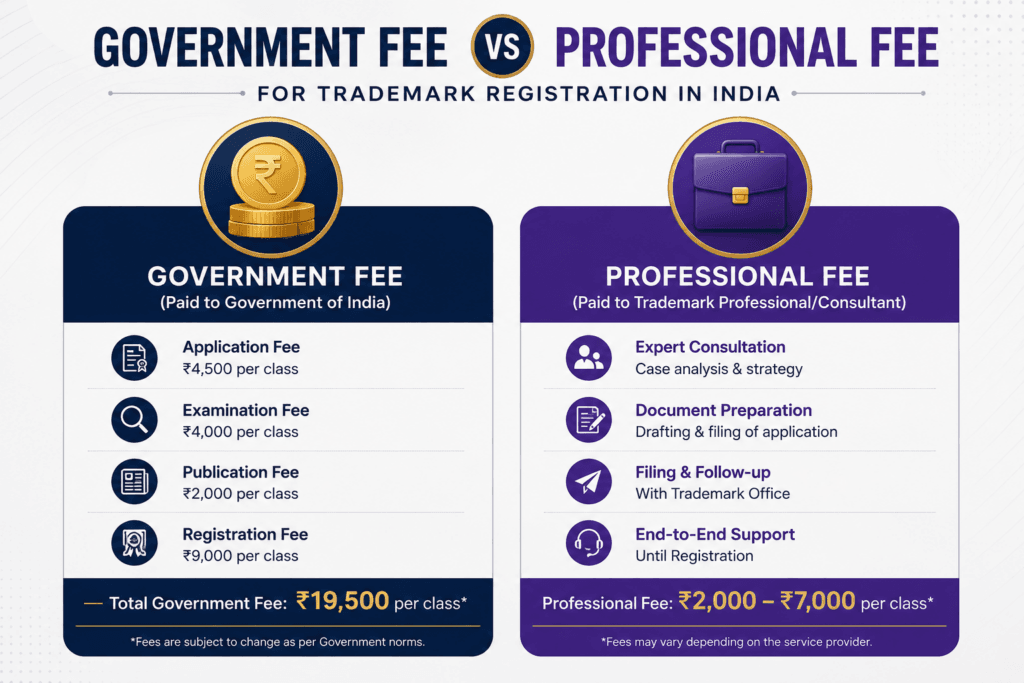
Trademark registration fees in India refer to the total cost involved in filing, examining, and registering a trademark with the Trade Marks Registry under the Trade Marks Act, 1999. These fees are not a single fixed amount — they depend on multiple factors such as applicant type, number of classes, filing mode, and whether professional assistance is used.
In simple terms, trademark registration fees in India generally include two major components:
Government Fee
This is the official fee paid to the Trade Marks Registry for filing and processing the application.
Professional Fee
This is the charge paid to a trademark agent, consultant, or agency for search assistance, documentation, and filing coordination.
Understanding both components is essential before comparing trademark registration fees in India across different service providers.
Government Trademark Registration Fees in India (2026)
The government portion of trademark registration fees in India is fixed by the Trade Marks Rules and depends on the applicant category and filing mode.
Fees for Individuals, Startups, and MSMEs
Individual applicants, recognized startups, and eligible MSMEs are usually charged a lower government fee compared to other entities. This concession is designed to encourage small businesses and first-time entrepreneurs to secure brand protection early.
Fees for Companies, LLPs, and Partnerships
Private limited companies, LLPs, and partnership firms fall under a different fee slab. Since these entities do not qualify for the small-enterprise concession, their government fee per class is generally higher than that of individuals or startups.
Fees for Multiple Trademark Classes
Trademark registration fees in India are charged per class, not as a flat one-time amount. If a business wants protection under more than one class — for example, both goods and services — the government fee is multiplied accordingly. This is one of the most common reasons the total trademark registration fees in India can increase quickly for businesses with diverse offerings.
Trademark Registration Fees in India: Class-Wise Breakdown
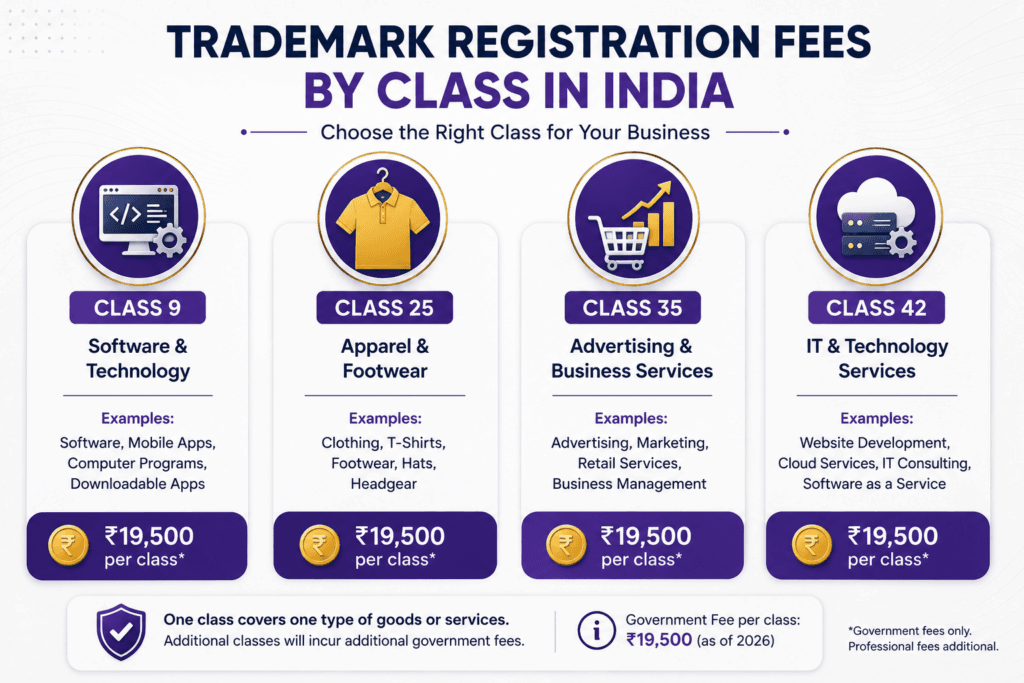
Since trademark registration fees in India are charged per class, it helps to see how different business categories are typically affected. The table below gives a general idea — always confirm exact figures with the current government notification before filing.
| Trademark Class | Common Use Case | Fee Impact |
|---|---|---|
| Class 9 | Software, apps, electronic devices | Standard per-class government fee |
| Class 25 | Clothing, footwear, apparel | Standard per-class government fee |
| Class 35 | Advertising, retail, business management | Standard per-class government fee |
| Class 42 | IT services, software development, consulting | Standard per-class government fee |
If your business operates across two or more of these categories — for example, a clothing brand that also runs an online store — you may need to file under multiple classes, which directly increases your total trademark registration fees in India. This is why choosing the right classes at the start, rather than adding them later, is one of the smartest ways to control cost.
Professional Charges Included in Trademark Registration Fees
Apart from the government fee, trademark registration fees in India also include professional charges when you hire an agent, consultant, or agency. These charges typically cover:
- Trademark search and availability check
- Class selection and application drafting
- Filing coordination with the Trade Marks Registry
- Status tracking and follow-up
- Guidance on responding to examination reports
Professional charges vary widely depending on the provider and the complexity of the application, so it is always a good idea to ask for a detailed breakdown before finalizing your trademark registration fees in India with any consultant.
Additional Costs: Objection and Hearing Charges
Not every application sails through without issues. If an objection is raised by the examiner, or if opposition is filed by a third party, additional professional charges may apply. Similarly, if a hearing is scheduled, representation charges can add to your overall trademark registration fees in India.
These additional costs are not always included in the initial quote, so applicants should clarify upfront whether objection handling and hearing charges are part of the trademark registration fees in India being quoted, or billed separately.
Trademark Registration Fees in India: Key Cost Factors
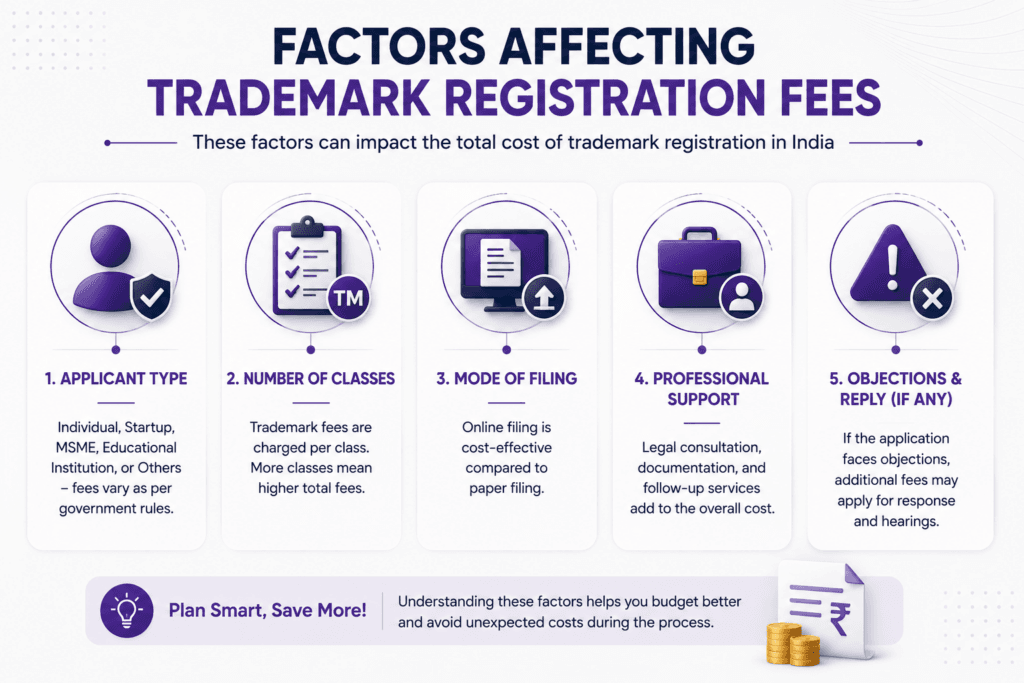
Several factors influence the final trademark registration fees in India that a business ends up paying:
Applicant Category
Individuals, startups, and MSMEs often pay lower government fees than companies or partnerships.
Number of Classes
More classes mean higher government fees, since each class is charged separately.
Filing Mode
Online filing is generally more economical than physical filing, which can affect overall trademark registration fees in India.
Professional Support
Choosing a consultant or agency adds professional charges on top of the government fee.
Objections and Opposition
Legal responses, hearings, and opposition proceedings can add unplanned costs later in the process.
How to Manage Trademark Registration Fees in India Efficiently
While you cannot avoid the mandatory government fee, there are practical ways to manage your overall trademark registration fees in India:
- Conduct a thorough trademark search before filing to reduce the chances of objection-related expenses.
- Select the correct class or classes the first time, instead of refiling later.
- Check if your business qualifies as a startup or MSME for reduced government charges.
- Ask professional service providers for a transparent, itemized quote covering search, filing, and follow-up support.
- Clarify in advance whether objection or hearing charges are included in the quoted trademark registration fees in India.
For a complete walkthrough of the process, documents, and eligibility, you can refer to this detailed guide on Trademark Registration in India, which covers everything from application to certificate issuance.
Trademark Registration Fees vs Renewal Fees
Many applicants focus only on the initial trademark registration fees in India and forget that a registered trademark is not protected forever. A trademark is generally valid for 10 years from the date of registration, after which it must be renewed. Renewal involves its own government fee, and if the renewal deadline is missed, additional restoration charges may apply on top of the standard renewal cost.
It is useful to think of trademark registration fees in India as the first step in an ongoing commitment, not a one-time expense. Budgeting for renewal in advance, rather than treating it as a surprise cost a decade later, is part of responsible brand management.
Documents Required Before Estimating Fees
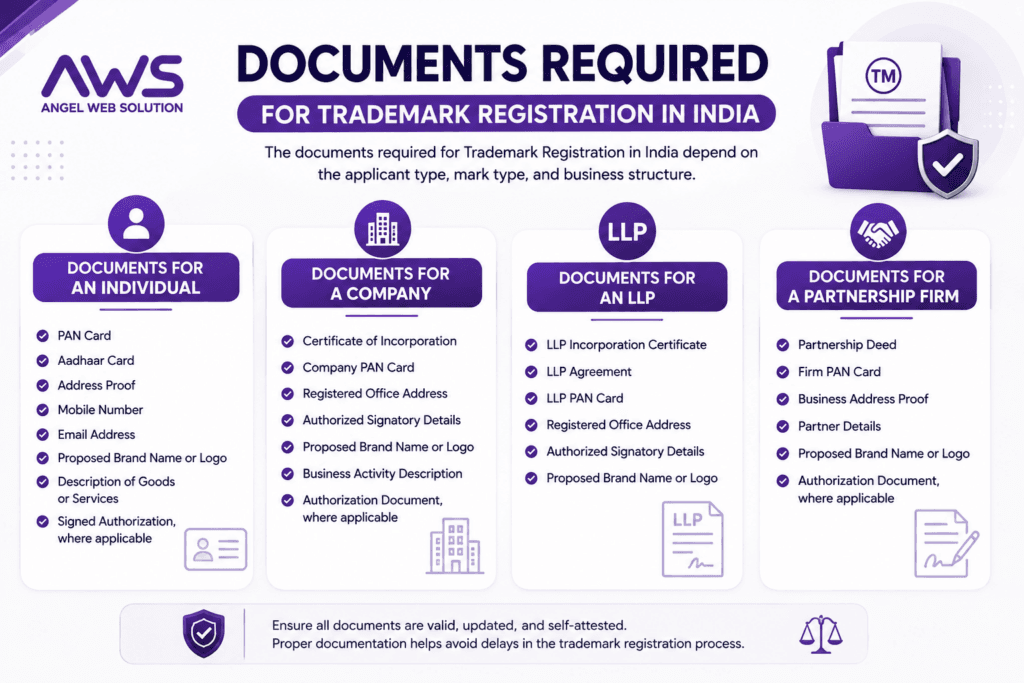
Your final trademark registration fees in India can also depend on how ready your documentation is. Common documents include:
- PAN card and address proof (for individuals)
- Certificate of incorporation (for companies)
- LLP agreement (for LLPs)
- Partnership deed (for partnership firms)
- Proposed brand name, logo, and description of goods or services
Having these documents ready in advance can speed up filing and reduce back-and-forth that sometimes leads to extra professional charges.
Trademark Registration Process at a Glance
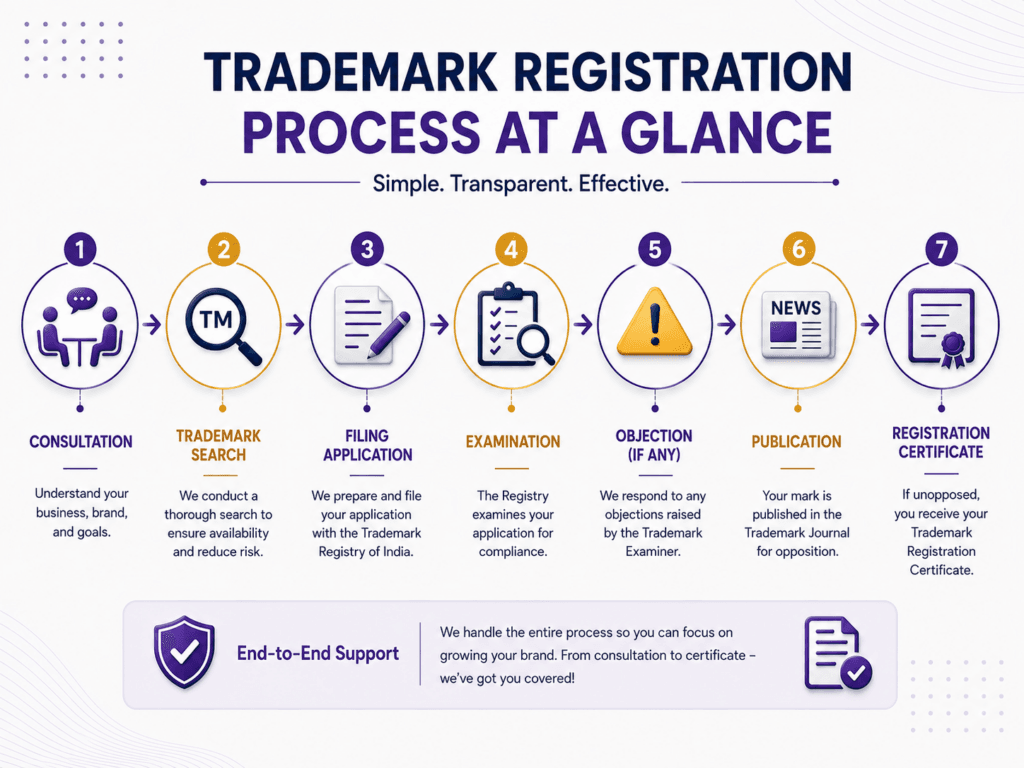
- Initial Consultation — Understanding the brand, business activity, and applicant type.
- Trademark Search — Checking for identical or similar existing marks.
- Application Filing — Submitting the application under the correct class.
- Examination — Review by the Trade Marks Registry for compliance.
- Objection Response — Replying with supporting documents, if required.
- Journal Publication — Publishing the mark for possible opposition.
- Registration Certificate — Issuance after successful completion.
Each of these stages can influence the total trademark registration fees in India, especially if objections or opposition arise midway.
Conclusion
Understanding trademark registration fees in India before you file can save you from unexpected costs later. By knowing the difference between government fees, professional charges, and additional costs like objections or hearings, you can plan your budget accurately and choose the right filing strategy for your brand. If you want expert help calculating your exact trademark registration fees in India based on your business type and classes, it is worth consulting a professional who can offer transparent, itemized pricing.